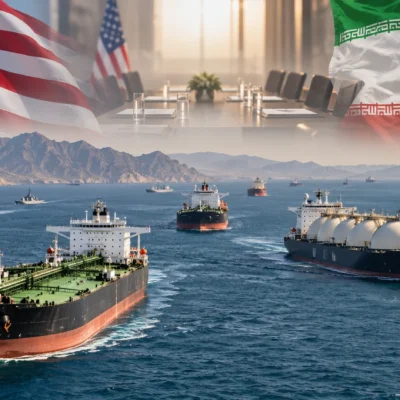

Iran–Oman diplomacy opens a narrow path toward safer navigation
Diplomatic activity between Iran and Oman is offering a rare opening in a crisis that has disrupted one of the world’s most important energy corridors.
On August 25, 2026, Omani Foreign Minister Sayyid Badr bin Hamad Al Busaidi travelled to Tehran and held talks with Iranian Foreign Minister Abbas Araghchi. The two sides said they had discussed a phased framework for restoring safe navigation through the Strait of Hormuz, including a proposed temporary joint navigational corridor and a joint project to clear mines from the waterway.
The development is significant because the Strait remains heavily disrupted after months of conflict and confrontation involving Iran and the United States. Reuters reported on August 26 that only a small number of commodity vessels were transiting the waterway, while preliminary Kpler data showed five commodity vessels crossed on August 25 compared with a 10-day average of 15.
Yet the diplomatic breakthrough is deliberately limited.
Iran has continued to link a full reopening of the Strait to broader issues involving the United States, including commitments under an earlier June memorandum of understanding. Tehran has also insisted that a separate Iran–Oman agreement on navigation does not by itself constitute a full reopening of Hormuz.
That distinction is crucial. The Iran–Oman initiative could make commercial navigation safer, but it cannot by itself resolve the larger Iran–U.S. dispute.
For global energy markets, however, even a limited reduction in risk could matter.
What happened in Tehran?
The latest diplomatic push followed weeks of intermittent discussions between Iran and Oman over how maritime traffic could safely move through the Strait.
During Al Busaidi’s August 25 visit, the two foreign ministers described their consultations as constructive and focused on restoring safe navigation while respecting the sovereignty and sovereign rights of coastal states.
Their proposed framework has several stages.
First, Iran and Oman would establish a temporary joint navigational corridor. Second, they would cooperate on a project to clear mines from the waterway. Technical negotiations would then continue on a more permanent arrangement covering navigation, traffic management, information-sharing and maritime-security services.
Iranian Deputy Foreign Minister Kazem Gharibabadi subsequently said the proposed temporary route would involve Iranian territorial waters for inbound traffic, while part of the outbound route would use both Iranian and Omani waters. Further negotiations were expected to continue over the following weeks.
The issue of mines is particularly important. The International Maritime Organization has repeatedly warned about the risks to commercial shipping and seafarers in the region. In June, the IMO said it had verified at least 46 attacks on international shipping in and around the Strait since the conflict began on February 28, with 14 seafarer fatalities at that point.
The proposed corridor therefore represents more than a diplomatic gesture. If implemented and independently assessed as safe, it could provide a mechanism for carefully controlled commercial traffic.
But it is not yet equivalent to normal navigation.
Why Oman matters
Oman’s importance comes from its unusual diplomatic position.
Unlike some regional states that have taken a more openly confrontational stance toward Tehran or Washington, Oman has historically maintained working relationships with both Iran and the United States.
That position has previously made Muscat a useful intermediary.
Oman played a significant role in facilitating secret U.S.–Iran contacts before the 2015 nuclear agreement, helping establish a channel through which officials from the two countries could communicate despite their lack of formal diplomatic relations.
That history gives Oman an asset that is particularly valuable during periods of heightened tension: trust as a communication channel.
The current crisis is more complicated, however. The dispute is not simply about nuclear negotiations. It also involves military confrontation, maritime security, sanctions, shipping access and competing interpretations of navigational rights.
Oman’s challenge is therefore to preserve its credibility with Iran while remaining acceptable to Washington and other Gulf states.
The August 25 joint statement indicated that Iran and Oman also see a role for other regional states. The two countries stressed the importance of discussions involving states bordering the Gulf and reaffirmed the need to respect international law and coastal states’ sovereign rights.
That could eventually turn a bilateral technical arrangement into a wider regional maritime-security mechanism.
Why the Strait of Hormuz matters to the world
The Strait of Hormuz is a narrow maritime passage between Iran and Oman connecting the Persian Gulf with the Gulf of Oman and the Arabian Sea.
Its importance is enormous because some of the world’s largest oil and gas exporters depend on it to reach international markets.
According to the U.S. Energy Information Administration, oil flows through Hormuz averaged 20.9 million barrels per day in the first half of 2025—roughly 20% of global petroleum-liquids consumption and about one-quarter of global maritime oil trade.
The International Energy Agency estimates that nearly 20 million barrels per day of oil passed through the Strait in 2025, while approximately 15 million barrels per day of crude oil transited the waterway. The IEA says about 80% of the oil passing through Hormuz is destined for Asia.
The LNG exposure is similarly significant.
The EIA estimates that 11.4 billion cubic feet per day of LNG moved through Hormuz in the first half of 2025, representing more than 20% of global LNG trade. Qatar is particularly important, while the UAE also exports LNG through the waterway.
The dependence is heavily concentrated in Asia. China, India, Japan and South Korea together accounted for approximately 74% of crude oil and condensate flows through Hormuz in the first half of 2025, according to the EIA.
This is why a disruption in Hormuz can quickly become a global economic problem.
Even when physical supplies do not immediately disappear, markets price in the possibility of shortages. Tanker rates can rise. War-risk insurance becomes more expensive. Refiners seek alternative grades and routes. Governments increase strategic-stock concerns. And consumers ultimately face higher energy costs.
Iran–U.S. tensions remain the biggest obstacle
The central problem is that the Iran–Oman discussions are taking place against a much larger Iran–U.S. confrontation.
Iran has repeatedly said that it is not currently negotiating directly with Washington. On August 3, Iranian Foreign Ministry spokesman Esmaeil Baghaei said Tehran was negotiating with Oman over safe passage through Hormuz rather than directly with the United States.
Iranian Foreign Minister Abbas Araghchi has separately said that reopening the Strait depends on broader conditions involving the United States and its commitments under the June memorandum of understanding.
Washington, meanwhile, has maintained economic pressure on Tehran.
The United States has expanded sanctions targeting Iran-linked entities and shipping interests, while the broader dispute has remained tied to questions over Iran’s nuclear program, regional security and maritime access. Reuters reported on August 25 that Washington had expanded sanctions but delayed enforcement of some measures amid diplomatic efforts.
The result is a complicated diplomatic equation:
Iran wants security and recognition of its interests in the waterway, while the United States wants unrestricted navigation and an end to what Washington views as Iranian threats to commercial shipping.
Oman is attempting to find practical ground between those positions.
What Iran and the United States want
Iran’s position
Tehran has emphasized that the Strait is subject to the sovereign rights of its coastal states and has rejected navigation arrangements it considers inconsistent with those rights.
Iran has also linked a full restoration of normal shipping to broader U.S. actions.
The distinction between the temporary Iran–Oman corridor and the wider reopening of Hormuz is therefore central to understanding the latest development.
Washington’s position
The United States has consistently emphasized freedom of navigation and the protection of commercial shipping.
The IMO’s previous statements demonstrate why the issue has become international rather than purely bilateral: attacks and navigation risks have affected civilian crews and international trade. In July, the IMO urged all relevant parties to exercise maximum restraint and facilitate the safe departure of ships stranded in the Gulf.
A sustainable arrangement will therefore require more than a route on a map. It will require confidence that vessels using the route will not become targets and that all sides will respect the agreed rules.
The economic stakes are already visible
Financial markets have reacted positively whenever diplomatic progress has raised expectations that Hormuz could reopen.
On August 25, Reuters reported that oil prices fell by more than $2 a barrel as investors responded to the renewed Iran–Oman discussions. Brent crude fell to around $86.28 a barrel, while U.S. West Texas Intermediate fell to approximately $80.29.
Indian markets also benefited from lower oil prices and improved sentiment. Reuters reported that the Nifty 50 rose 0.17% and the BSE Sensex 0.41% on August 26, with oil marketing companies including BPCL, HPCL and Indian Oil gaining as crude prices declined.
But markets remain cautious.
The IEA warns that even a short-lived disruption to Hormuz can have a significant effect on oil markets. Alternative pipelines through Saudi Arabia and the UAE can redirect only part of the affected volumes. The IEA estimates available alternative capacity at roughly 3.5–5.5 million barrels per day, far below the volumes normally moving through the Strait.
That imbalance explains why diplomacy has an immediate economic value.
A credible path toward safer shipping can reduce the risk premium embedded in oil prices even before full traffic resumes.
India has a particularly strong interest in a solution
For India, the Strait of Hormuz is more than a geopolitical concern. It is directly connected to energy security.
India has diversified its crude supplies substantially in recent years, particularly through increased Russian imports. That diversification has reduced the country’s dependence on any single route.
Nevertheless, India remains deeply exposed to Gulf energy flows.
The Indian government said in March that approximately 70% of India’s crude imports were then arriving through routes outside Hormuz, compared with about 55% before the conflict. But it also highlighted a major vulnerability in LPG: India imports around 60% of its LPG consumption, and approximately 90% of those imports historically came through Hormuz.
LNG is another concern.
Indian customs data reported by India Today showed that suppliers loading inside the Strait accounted for 61% of India’s LNG imports in 2025. During April and May 2026, however, Qatar’s shipments to India fell sharply as Indian buyers shifted toward suppliers including the United States, Oman, Nigeria, Trinidad and Angola.
That demonstrates India’s ability to adapt—but also the cost of doing so.
Alternative supplies may require longer shipping distances, different infrastructure, higher freight costs or more expensive cargoes.
A prolonged Hormuz crisis could therefore affect India’s:
- crude-oil import bill;
- LPG availability and prices;
- LNG procurement costs;
- inflation;
- rupee and current-account pressures;
- shipping and war-risk insurance costs;
- aviation and transport fuel costs.
The Indian government has already emphasized continuity of energy supplies and monitoring of Indian vessels in the Gulf.
Diplomatic stabilization would therefore serve India’s interests even if India itself is not a direct party to the Iran–U.S. dispute.
Regional support could strengthen Oman’s effort
The Oman–Iran initiative is also attracting wider regional attention.
Qatar’s Prime Minister and Foreign Minister Sheikh Mohammed bin Abdulrahman bin Jassim Al Thani spoke with Omani Foreign Minister Badr Al Busaidi on August 25 about the developments. Qatar expressed support for Oman’s diplomatic efforts aimed at de-escalation and regional stability.
That matters because Qatar is one of the countries most economically exposed to any prolonged disruption in Hormuz.
The EIA estimates that Qatar accounted for the overwhelming majority of LNG moving through the Strait from Persian Gulf producers, while China, India and South Korea were among the largest destinations.
A broader Gulf dialogue could therefore create shared incentives around a simple objective: keeping commercial shipping moving without turning maritime navigation into another battlefield.
Timeline: How the crisis reached this point
February 28, 2026: The current conflict affecting the Strait began, according to the IMO’s chronology of attacks and maritime disruption.
June 2026: The United States and Iran announced a memorandum of understanding that temporarily raised hopes for improved security and reopening of the waterway. The IMO welcomed the agreement as a potential step toward restoring maritime security.
June 23: The IMO announced an evacuation framework for more than 11,000 seafarers stranded in the region, working with Iran, Oman, the United States and other partners.
June 25: The IMO paused the evacuation operation following an attack on a vessel in the Gulf of Oman.
August 3: Iran said there were no current direct negotiations with the United States and that discussions with Oman were focused on safe passage through Hormuz.
August 25: Omani Foreign Minister Badr Al Busaidi travelled to Tehran and met Iranian Foreign Minister Abbas Araghchi. The two sides announced a phased framework involving a temporary navigational corridor and joint mine-clearance work.
August 26: Iranian officials said a temporary route had been agreed in principle, while stressing that full reopening of the Strait remained dependent on broader issues involving the United States.
What could happen next?
1. A controlled reopening
The most constructive scenario would see Iran and Oman implement the temporary corridor, complete sufficient mine-clearance operations and establish procedures for commercial traffic.
This could gradually restore confidence among shipowners and insurers.
2. A limited humanitarian and commercial corridor
Even if political disagreements remain unresolved, the two sides could create a narrow arrangement allowing essential commercial shipping to move under controlled conditions.
This would not amount to a full political settlement, but it could reduce economic pressure.
3. Renewed Iran–U.S. negotiations
If the maritime arrangement proves workable, Oman could use it as a confidence-building measure to reopen indirect communication between Tehran and Washington.
That could eventually bring nuclear issues, sanctions and maritime security back into a broader negotiating framework.
4. Prolonged partial disruption
This may be the most realistic near-term risk.
The temporary corridor could exist on paper while commercial shipping remains limited because insurers, shipowners and crews remain unwilling to accept the security risks.
Reuters reported on August 26 that traffic remained well below normal levels, illustrating the difference between a diplomatic announcement and actual market normalization.
5. Renewed military escalation
The most dangerous scenario would be a new attack on commercial shipping, mine incident or military confrontation.
Such an event could quickly reverse the recent decline in oil prices and push tanker insurance, freight costs and energy risk premiums higher.
What to watch now
The next few weeks will be critical.
Markets and governments will be watching for:
- confirmation that the temporary Iran–Oman corridor is operational;
- details of the route and vessel eligibility;
- evidence that mine-clearance operations are progressing;
- actual increases in commercial vessel traffic;
- U.S. acceptance or rejection of the proposed framework;
- any movement toward renewed U.S.–Iran negotiations;
- further Iranian statements about conditions for reopening Hormuz;
- changes in sanctions policy;
- tanker attacks or other maritime incidents;
- movements in Brent and WTI crude prices;
- shipping and war-risk insurance rates;
- responses from Qatar, Saudi Arabia, the UAE, Kuwait, India, China, Japan and South Korea.
The most important indicator will ultimately be simple: whether commercial vessels begin moving through Hormuz in meaningful numbers again.
Can Oman prevent a wider Iran–U.S. confrontation?
Oman cannot resolve the Iran–U.S. conflict by itself. Nor can a bilateral agreement over a shipping lane solve disputes over nuclear policy, sanctions, military deployments or regional security.
But Muscat may be able to accomplish something more practical—and potentially more important in the short term.
It can create space for diplomacy.
The temporary corridor discussed by Iran and Oman provides a mechanism for separating at least one urgent issue—safe maritime navigation—from the larger political dispute.
That distinction could be valuable.
A shipowner does not necessarily need Tehran and Washington to agree on every geopolitical question. What the shipping industry needs is confidence that a vessel can pass through a defined route without being attacked, detained or caught in military operations.
The same logic applies to energy markets.
If Iran and Oman can establish a credible, verifiable and secure corridor, even limited traffic could reduce some of the extreme risk premium surrounding Hormuz. If the arrangement then becomes a confidence-building measure for wider negotiations, its importance would extend far beyond maritime navigation.
But optimism should remain cautious.
The Strait is still operating far below normal levels. Iran continues to tie full reopening to broader U.S. commitments, while Washington’s sanctions and security policies remain a major source of friction.
The Iran–Oman initiative is therefore best understood not as a solution to the crisis, but as a potential first bridge out of it.
For a waterway carrying roughly one-fifth of the world’s petroleum-liquids consumption and more than one-fifth of global LNG trade, even that limited diplomatic opening matters.
The immediate test is whether words become safe passage.
If they do, Oman could once again demonstrate the value of quiet regional diplomacy—and potentially help turn the Strait of Hormuz from a flashpoint back into a functioning artery of global commerce.