
Global Economy in Crosscurrents of War and Technology
The global economy is navigating a precarious, two-speed recovery, defined by the tug-of-war between the disruptive volatility of the West Asia conflict and the productivity-enhancing tailwinds of the artificial intelligence (AI) boom. In its latest World Economic Outlook (WEO) update, the International Monetary Fund (IMF) has adjusted its 2026 global growth projection downward to 3.0%, a marginal trim from its April forecast. While the Fund warns that the disinflation trend has stalled, it maintains that the global system has “weathered the shock” of regional instability better than initial models predicted, thanks largely to a massive surge in tech-sector capital expenditure.
The Shift Toward a Baseline Forecast
For much of early 2026, the IMF operated under a shroud of extreme uncertainty, balancing a panoply of “worst-case” scenarios regarding global energy supply. Today, however, the Fund has shifted to a more stable baseline projection. The outlook now favors a “V-shaped” recovery path, with growth expected to accelerate to 3.4% in 2027.
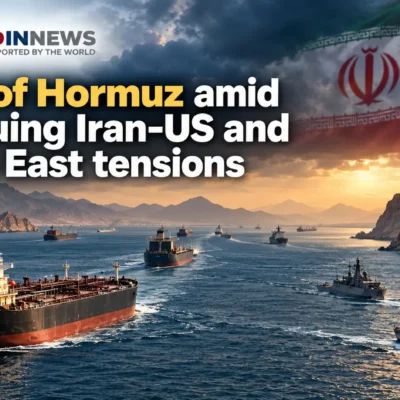
This transition reflects the realization that commercial and strategic destocking have successfully cushioned the blow of restricted energy flows through the Strait of Hormuz. By moving away from hyper-pessimistic stress tests, the IMF suggests that the global economy has developed a structural resilience, even as growth remains below the 3.5% average observed in 2024–25.
Growth Revisions: A Snapshot
The impact of current geopolitical and technological forces is uneven, creating distinct winners and losers based on energy dependence and participation in the technology value chain.
- Global Economy: 3.0% (down from 3.1% in April)
- United States: 2.3% (unchanged; supported by energy independence and AI-led investment)
- Eurozone: 0.9% (down from 1.1%; hampered by energy costs and weak consumer confidence)
- India: 6.4% (down from 6.5%; remains among the world’s fastest-growing economies)
The Tech Buffer: Productivity vs. Energy Shock
A critical narrative in the July update is the role of technology as an economic shock absorber. While the conflict in West Asia acts as a persistent drag on energy-importing nations, the “AI-led upturn” is providing a powerful, demand-driven offset.
The IMF notes that countries integrated into the global technology value chain—specifically those involved in AI hardware manufacturing and cloud infrastructure—are experiencing stronger activity that masks the underlying energy-related slowdown. This productivity strength, particularly in the U.S., has allowed business investment to remain resilient even as manufacturing PMIs in other regions point to softening momentum.
Risk Assessment: The Fragility of the Status Quo
Despite the tempered optimism, the IMF’s warnings remain stark. The primary risks are no longer abstract; they are concentrated around the security of maritime chokepoints and commodity price volatility.
The Fund highlights that the ongoing closure of the Strait of Hormuz remains a focal point of systemic fragility. Furthermore, the IMF warns that the current economic stability relies heavily on an assumption of status quo in the Middle East. Should a potential peace deal collapse or geopolitical tensions escalate significantly, the “temporary relief” currently provided by energy stockpiles would evaporate, likely leading to a sharp inflation spike and a reversal of the projected 2027 growth rebound.
What this means for investors
Investors should anticipate continued divergence in regional performance. The “tech-buffer” thesis suggests that capital allocation should favor economies and corporations deeply embedded in the AI hardware and software supply chains, as they remain insulated from energy-price volatility. However, with global inflation projected to rise to 4.7% in 2026, the era of easy disinflation has effectively paused, signaling that central banks may keep interest rates “higher for longer.” Investors should hedge against the “tail risk” of a further escalation in West Asia, which remains the single greatest threat to the current, fragile growth baseline.
As we look at the divergence between tech-resilient economies and those struggling with energy costs, which region do you believe is best positioned to navigate these crosscurrents if the conflict in West Asia intensifies in Q4 2026?