
Introduction
Artificial Intelligence (AI) has become more than just another technological trend—it is now a strategic asset shaping economies, governments, businesses, and societies worldwide. In 2026, the competition between China and the United States has intensified, with both countries striving to lead the next generation of AI innovation.
While the United States remains home to many of the world’s most influential AI companies, China has accelerated national investments, strengthened public-private partnerships, and expanded AI adoption across manufacturing, healthcare, finance, transportation, and defense.
This competition is not merely about creating smarter algorithms. It is about determining who will define the technological standards, economic leadership, and geopolitical influence of the coming decades.
Why AI Leadership Matters
Artificial intelligence is transforming nearly every industry. Countries leading AI development gain significant advantages, including:
- Increased economic productivity
- Faster scientific discoveries
- Advanced healthcare solutions
- Smarter manufacturing
- Stronger cybersecurity
- Military modernization
- Improved public services
According to industry estimates, AI could contribute trillions of dollars to the global economy over the next decade, making leadership in AI a national priority for major economies.
China’s AI Strategy in 2026
China has adopted a coordinated national approach to AI development. Government agencies, universities, research institutes, and private technology companies collaborate to accelerate innovation.
Key priorities include:
Massive Investment
China continues investing heavily in:
- AI research
- Semiconductor manufacturing
- Quantum computing
- Robotics
- Smart cities
- Autonomous transportation
Large-scale public funding has enabled rapid commercialization of AI technologies.
AI in Manufacturing
Chinese manufacturers increasingly integrate AI into production lines using:
- Predictive maintenance
- Industrial robotics
- Computer vision
- Quality inspection
- Supply chain optimization
This improves efficiency while reducing production costs.
Healthcare Innovation
Hospitals are adopting AI for:
- Medical imaging
- Disease prediction
- Drug discovery
- Personalized treatment
- Hospital workflow optimization
AI is helping healthcare providers improve both speed and accuracy.
America’s AI Strengths
The United States continues to lead several critical areas.
World-Class AI Companies
Many of the world’s leading AI developers operate in the United States, driving breakthroughs in:
- Large Language Models
- Cloud AI
- AI Software
- Enterprise AI
- Robotics
- Autonomous Vehicles
These companies continue attracting global talent and investment.
Research Excellence
American universities remain leaders in AI research, producing innovations that shape both academic and commercial applications.
Strong collaboration between universities, startups, and private companies accelerates technological progress.
Venture Capital
The U.S. continues to dominate AI startup funding, enabling entrepreneurs to rapidly commercialize new technologies.
Key Areas of Competition
Semiconductor Manufacturing
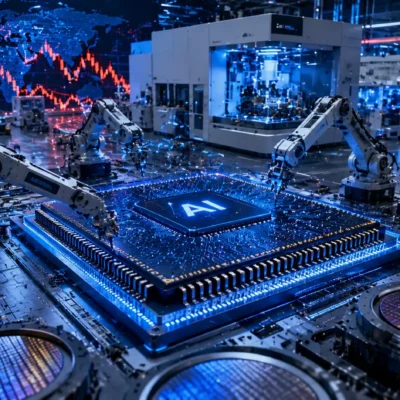
Advanced AI depends on powerful semiconductor chips.
Both nations are investing billions to strengthen domestic chip production and reduce dependence on foreign suppliers.
Generative AI
Generative AI has transformed:
- Content creation
- Programming
- Marketing
- Customer support
- Healthcare
- Education
Competition in foundation models continues to intensify.
Robotics
AI-powered robots are becoming common in:
- Manufacturing
- Warehousing
- Agriculture
- Logistics
- Healthcare
Automation is increasing productivity while reducing repetitive labor.
Autonomous Transportation
Both countries continue developing:
- Self-driving vehicles
- Autonomous trucks
- Delivery robots
- Smart traffic management
- AI-powered logistics
Economic Impact
AI is becoming a major driver of economic growth.
Businesses using AI benefit from:
- Lower operating costs
- Better decision-making
- Increased productivity
- Enhanced customer experiences
- Faster innovation
Countries leading AI development are expected to gain long-term competitive advantages in global trade and technology exports.
Challenges Facing Both Countries
Despite rapid progress, significant challenges remain.
Data Privacy
Balancing innovation with user privacy continues to be an important issue.
AI Ethics
Governments and businesses must ensure AI systems remain:
- Fair
- Transparent
- Accountable
- Secure
Talent Shortage
Demand for AI engineers, researchers, and data scientists continues to exceed supply.
Cybersecurity
AI systems themselves are becoming targets for cyberattacks, requiring stronger security measures.
Global Impact
The AI competition extends beyond China and the United States.
Countries across Europe, India, Japan, South Korea, Singapore, and the Middle East are investing heavily in:
- AI education
- AI startups
- Research infrastructure
- Semiconductor manufacturing
- Digital transformation
International collaboration and competition are shaping a truly global AI ecosystem.
Future Outlook
Over the next decade, AI is expected to become deeply integrated into daily life.
Future developments may include:
- AI-powered healthcare assistants
- Smarter factories
- Autonomous public transportation
- Personalized education
- Intelligent financial systems
- Advanced climate modeling
- Scientific research acceleration
Rather than producing a single winner, the future of AI may be defined by multiple regional innovation hubs collaborating and competing simultaneously.
Conclusion
The AI race between China and the United States represents one of the defining technological competitions of our time. While China leverages coordinated national planning and large-scale industrial adoption, the United States continues to benefit from world-leading research institutions, innovative startups, and a vibrant technology ecosystem.
As AI reshapes industries and societies, responsible innovation, international cooperation, and ethical governance will be just as important as technological breakthroughs. Organizations and policymakers that adapt to this rapidly evolving landscape will be best positioned to thrive in the AI-driven economy.
Frequently Asked Questions
What is the China vs US AI race?
It refers to the competition between China and the United States to lead global artificial intelligence research, innovation, infrastructure, and commercialization.
Why is AI so important?
AI improves productivity, drives innovation, supports economic growth, enhances healthcare, strengthens cybersecurity, and transforms industries.
Which industries benefit most from AI?
Manufacturing, healthcare, finance, transportation, education, logistics, retail, and energy are among the sectors seeing significant AI adoption.
Will AI replace human jobs?
AI is expected to automate some repetitive tasks while creating new opportunities in AI development, data science, cybersecurity, robotics, and digital services.
Why are semiconductors critical for AI?
Advanced AI models require powerful chips to train and run efficiently, making semiconductor technology a strategic priority.