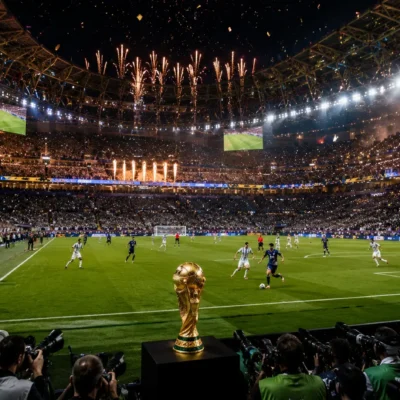

Underdogs and Anthems: The Defining Moments of the 2026 World Cup So Far
The air in North America is thick with something more than just summer heat; it is charged with the unmistakable, high-frequency hum of football history being written in real-time. As we descend into the quarterfinal stages of the 2026 FIFA World Cup, the tournament has evolved from a grand experiment into a cultural phenomenon.
From the concrete canyons of Mexico City to the rain-kissed lawns of Vancouver and the vibrant avenues of Miami, the pulse of this World Cup is anchored by the infectious rhythm of “Dai Dai.” The official anthem, a masterclass in global fusion by Shakira and Burna Boy, has become more than a stadium track—it’s the heartbeat of a generation. Whether it’s a fan-made dance challenge on social media or the stadium-wide singalongs before kick-off, “Dai Dai” has bridged the gap between continents, proving that even in a tournament spanning three nations, a singular melody can bind the world together.
The 48-Team Gamble: Parity in Practice
Critics once scoffed at the expansion to a 48-team format, fearing a dilution of quality. Instead, the 2026 edition has delivered something entirely more compelling: pure, unadulterated opportunity. The expanded field has provided a massive stage for nations long relegated to the periphery.
We saw this “underdog effect” ripple through the early stages and into the Round of 16. Nations like Cabo Verde—making their historic debut—pushed seasoned giants to their absolute limit. The tactical landscape has shifted accordingly. Defensive discipline, once the hallmark of the “lesser” nations, has evolved into sophisticated, high-pressing systems that force powerhouses to gamble. When England faced a gritty, resilient Mexico in the Round of 16, they didn’t just walk through the door; they were forced to battle through a tactical storm, eventually narrowly securing a 3-2 victory in a match that will be remembered for its chaotic intensity and a controversial red card.
High Stakes and Heavy Hearts
As we arrive at the quarterfinals, the narrative has shifted from discovery to desperation. The margin for error has vanished. For stars like Harry Kane and Erling Haaland, this stage is a crucible. History is no longer being written; it is being carved out with every tackle and every misplaced pass.
Take the upcoming clash between England and Norway—a fixture that, despite their history, feels like a brand-new chapter. With Haaland leading the line for the Norwegians and Kane spearheading the English attack, the game is set to be a clash of clinical archetypes. Conversely, the Argentina-Switzerland match offers a different kind of tension. Argentina, fresh from a high-wire act against Egypt, faces a Swiss side that has quietly, efficiently, and brilliantly navigated its way to the final eight for the first time since 1954.
Beyond the Pitch: A Cultural Shift
The true success of the 2026 World Cup lies in the “human element.” It’s found in the diverse sea of colors in the stands, where local traditions blend with the traveling supporters’ flair. The infrastructure in North America has held firm under the weight of this massive influx, but it’s the community celebrations—from public watch parties in downtown plazas to the way the anthem has been adopted by local radio stations—that have truly defined the tournament’s impact.
We are witnessing a “tournament of arrival.” For football in North America, this is the watershed moment. The crowds aren’t just here to witness the sport; they are participating in it. The energy in the stadiums, the viral reach of the anthem, and the genuine shock of seeing smaller nations hold their own against historical titans have created a sustainable excitement that will outlast the trophy ceremony.
The Road Ahead
As we look toward the semifinals, one thing is certain: the 2026 World Cup has proven that football’s appeal is truly universal. By democratizing the field and inviting the world to share in a singular, vibrant rhythm, this tournament has successfully redefined what a global sporting event looks like in the modern era. Whether it’s France’s calculated precision or the sheer, relentless hunger of the tournament’s remaining underdogs, the quest for the title is now a test of character.
The anthem says it best: Dai Dai—come on. The world is watching, the rhythm is set, and the next few days will decide which nation etches its name into the history books forever.
With the semifinals looming and the tension reaching a fever pitch, how do you see the tactical battle between the remaining giants—France, Spain, Argentina, and the dark-horse contenders—playing out in the closing act of this tournament?